
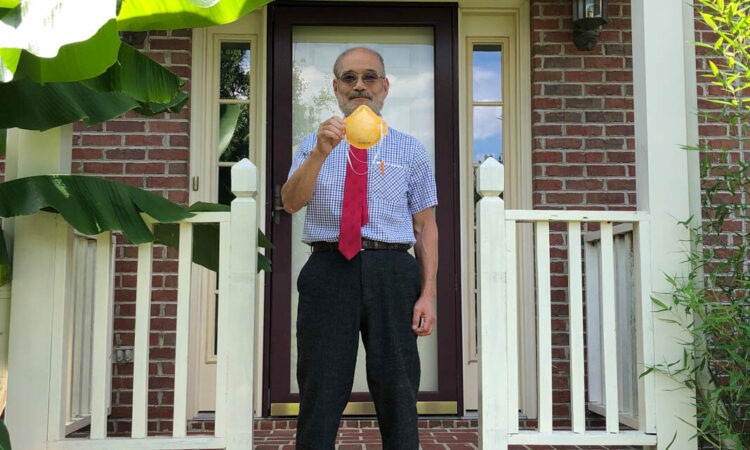
Dr. Tsai was born in Taiwan. He studied at National Taipei Institute of Technology, then worked at what is now Taiwan Textile Institute. He immigrated to the United States in 1981 to pursue graduate studies at Kansas State University. He ultimately went to the University of Tennessee to begin PhD coursework in materials science, eventually leading to the development of electrostatically charged fiber technology.
Dr. Tsai patented the technology that made the N95 mask possible while at UT. Originally, the technology was meant for use in construction and home air filters (think HVAC). Dr. Tsai discovered that fibers could be electrostatically charged, with both positive and negative charges, to attract particles and thereby filter air. The polarization captured 95 percent of submicron particles, including dust, haze, pollen, and smoke. This filtering reduced the risk of exposure to particles in construction materials or coal dust which can lead to pulmonary or lung diseases. It was later discovered by the U.S. Centers for Disease Control that the technology was also effective at trapping viruses, bacteria and other airborne diseases, leading to the proliferation of its use in hospitals. Prior to Dr. Tsai’s invention, masks mechanically trapped particles in their fibers. Use of the electrostatically charged fibers was 10 times more efficient.
The patents relating to the N95 technology include U.S. 5,686,050. The novelty of this patent was its cold charging that did not bleed off over time. Previous technologies used hot electrostatic charging methods which resulted in charge densities that were insufficient to effectively filter particles from air flows. This was accomplished by subjecting a “web” to a positive charge on one side and a negative charge on the other, then switching sides, such that the first side is subjected to the negative charge and the second side to a positive charge.
Aside from electrostatic charging, Dr. Tsai specialized in melt blowing, a process of scattering a polymer resin at a high enough air velocity to form nonwoven fabric. In total, Dr. Tsai holds over 20 commercial license agreements and 12 U.S. patents.
Author: Jake R. Dinkins